
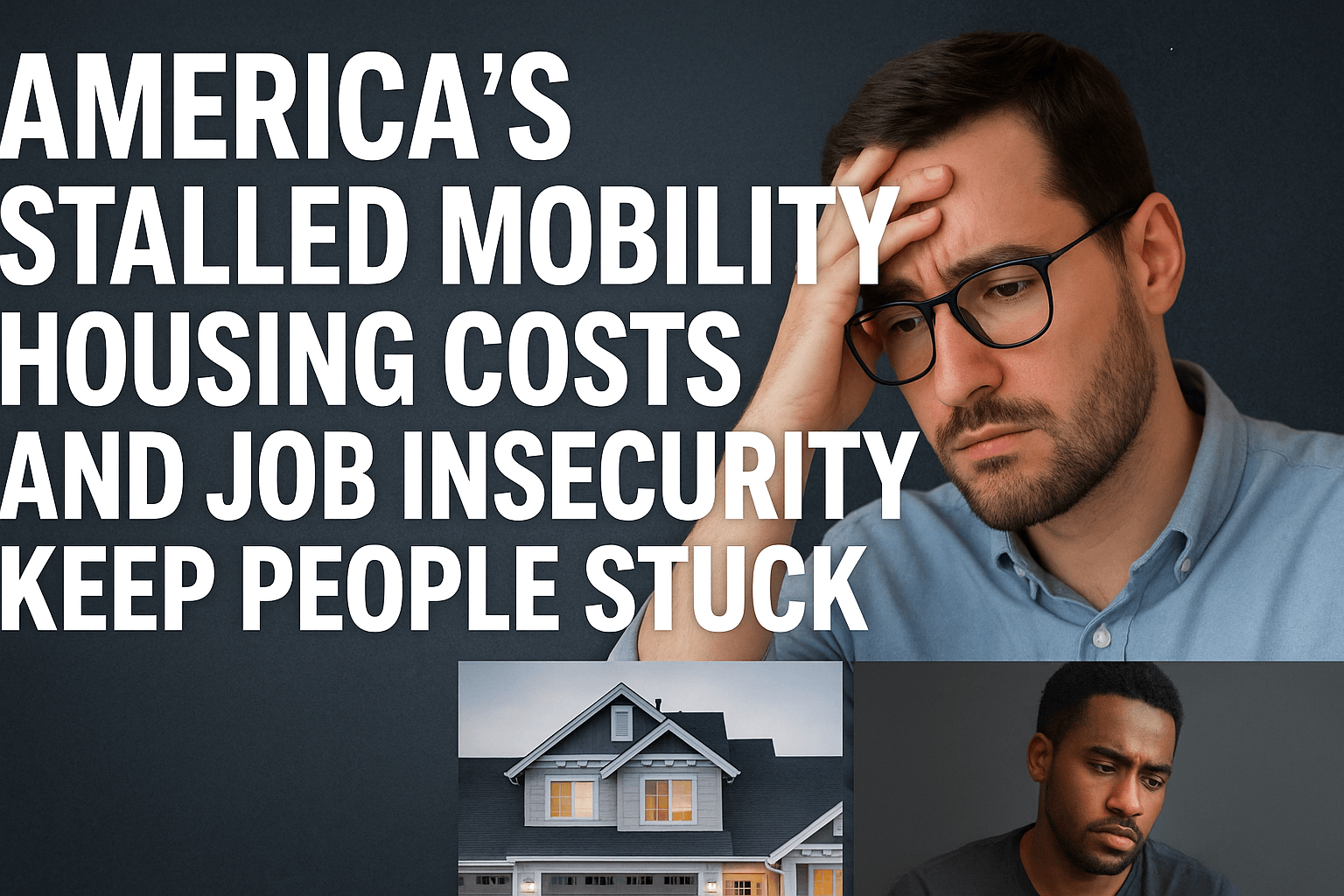
People are moving to new homes and new cities at around the lowest rate on record. Companies have fewer roles for entry level workers trying to launch their lives. Workers who do have jobs are hanging on to them. Economists worry the phenomenon is putting some of the country’s trademark dynamism at risk.”
For generations, Americans moved “from city to city, state to state” in search of opportunity. That defining feature of the U.S. economy “has stalled, leaving many people in homes that are too small, in jobs they don’t love or in their parents’ basements looking for work.”
The Housing Squeeze
“In the 1950s and ’60s, some 20% of Americans would typically move each year.” By 2019, “9.8% of Americans moved.” During Covid, migration spiked briefly, but “in 2023, only 7.8% of Americans moved, the lowest rate logged since U.S. Census records began in 1948. That figure held relatively steady in 2024.”
The sharpest drop was “a roughly 47% decline among people moving within the same county over the past three decades, according to census data.”
Families like Brandon and Katherine Righi in New Jersey are stuck. They bought a small home in 2017 but with higher mortgage rates, “a bigger home would at least double the family’s monthly payment. They abandoned their plans and are staying put for now.”
Empty nesters are also locked in place. Bob Ruffatto explained, “I’m in a home that should be occupied by a family with small kids. I’m clogging that.”
Housing affordability is worsening. “For much of the 2010s, a median income family who bought a median priced home spent 30% or less of their earnings on housing costs, according to brokerage Redfin. That share is now 39%. Last year, home sales fell to the lowest level in almost 30 years.”
A Stagnant Job Market
“When the U.S. started to reopen from pandemic lockdowns, companies couldn’t hire workers fast enough and job applicants could name their price. Today, the job market has slowed notably.”
Hiring and turnover “fell last year to its lowest level since 2009.” Workers are staying put, with “the probability that a worker would switch employers in any month” now averaging 2.3%, down from 2.8% in the late 1990s.
Fear of layoffs is one reason. “In a recent poll by job listing site Indeed, half of respondents said they are sticking to their current job because they don’t want to worry about being laid off as the newest hire.”
This creates an “insider outsider divide,” with recent graduates most affected. A study found that “graduates who are underemployed are more than three times as likely to be underemployed a decade later than those who quickly secure a good job.”

The ‘Golden Handcuffs’ Effect
“Those who bought homes when mortgage rates were low or have stable white collar jobs are clinging to them rather than taking big leaps.”
Recruiters report that relocation willingness is collapsing. “During the 2022 24 period, about 10% of jobs that recruiting and staffing firm Kelly Services’s engineering division placed candidates in required relocating. Now, the figure is closer to 2% or 3%.”
Mark Saltrelli of Kelly Services said, “The golden handcuffs right now in the market are tighter than ever.”
Dual income households further complicate moves. As Richmond Fed economist John Jones explained, “Couples where both people work had the lowest levels of interstate mobility of any group.”
Stories of Being Stuck
For young graduates, the challenge is acute. Josue Leon, a first generation college graduate, sent “over 200 job applications since April, piling up credit card debt and living in his girlfriend’s family’s home.” He turned down an early offer that required relocation because “moving to Massachusetts with almost no money is very difficult.”
Another graduate, Grace Ahn, described her struggle: “At first I was so naive, so excited. I was like, the whole world is my oyster. The oyster has now expired.”
Others refuse to uproot their families. Project manager Craig Allen, laid off in Maryland, said, “Moving to another city for a job would be the plan of last resort.”
The Bigger Economic Picture
Economists see consequences nationwide. Declining mobility, said Chang Tai Hsieh of the University of Chicago, is “a big deal in so many dimensions.” His research shows that “expensive housing dissuaded so many workers from moving for better jobs that it weighed on U.S. gross domestic product.”
The result: families stuck in homes that don’t fit, workers trapped in jobs they don’t love, and companies struggling to fill roles. “The golden handcuffs right now in the market are tighter than ever
Why Sam Altman and Mark Cuban Say Jobs Are About to Disappear