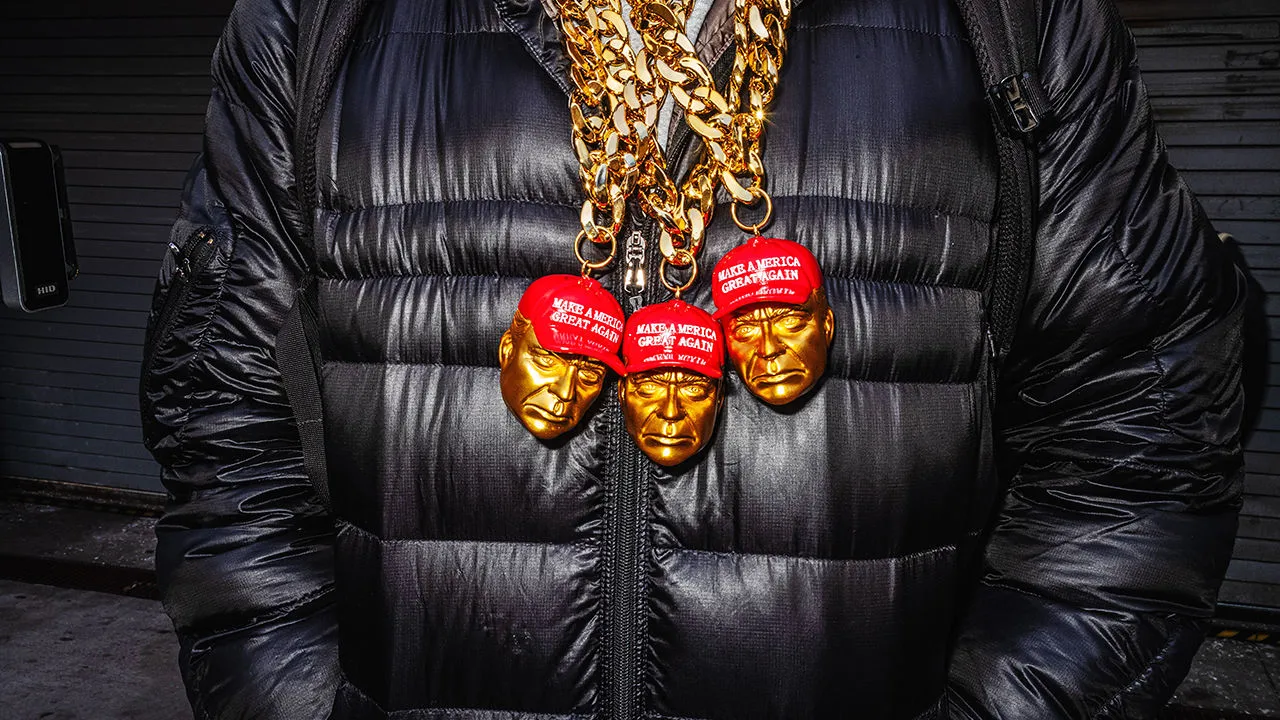
Imagine the perfect morning.” You sleep on MyPillow sheets—courtesy of Mike Lindell, the conspiracy theorist. You sip Black Rifle Coffee, which “serves coffee and culture to people who love America”. Then comes a shave with Jeremy’s Razors (“built for rugged jawlines….not feelings”), followed by bacon from Good Ranchers, pledging to “make the American farm strong again”. And to top it off, a spin on your Harley-Davidson.
The MAGA economy, it turns out, is more than a few marketing slogans. The broader conservative universe now stretches far beyond flag-waving branding. It includes products and employers simply favored by Republicans. “And each economic choice adds up to something bigger.” The world’s largest market is becoming two: one conservative, the other liberal.
A Nation Divided by Dollars
“America is splitting into two different economies and markets.” People not only think differently about the economy—they buy different goods and work in increasingly different industries. Despite being looked down upon by liberals, the MAGA economy is “doing surprisingly well.”
Liberals often dismiss conservative companies. Partly, it’s politics. But partly, it’s skepticism. Trump’s crypto coin surged after launch—then crashed, “leaving many supporters holding the bag.” His “Fight Fight Fight” branded watches cost up to $100,000 and received mixed reviews.
Still, this sense of superiority “reflects a belief that the conservative economy is backward.” Hillary Clinton noted she had “won the places that represent two-thirds of America’s gross domestic product…the places that are optimistic, diverse, dynamic, moving forward.” Kamala Harris, in 2024, won a similar share of GDP.
But places like Yuba City, California—a stronghold for Trump voters, filled with farmers and hardware stores—are doing better than before. “Even places like Yuba City are doing better than before and together MAGA-land is enormously powerful.” If Democrats command two-thirds of the GDP, Republicans still represent a $10 trillion economy—enough to be the third-largest in the world.
Living in Parallel Realities
Survey data reveals deep partisan divides in economic perception. “Before the presidential election 50% of Democrats believed that the economy was getting better, against just 6% of Republicans. Today 8% of Democrats and 49% of Republicans respond in the same way.”
Hard data matches the sentiment. A paper by Verena Schoenmueller (Esade University) and co-authors suggests consumption is splitting. After Trump’s 2016 victory, liberals “possibly compensated…by stronger support for liberal-oriented brands”—like Patagonia. Tesla now showcases partisanship in real time. TD Cowen forecasts Elon Musk’s alliance with Trump will “reduce sales by more than 100,000 vehicles a year in Democratic-leaning counties, while boosting sales by twice as much in Republican ones.”
New York vs. Wyoming: A Spending Split
Official stats confirm the divide. Since the 1990s, blue state residents spend more on “blue” goods like public transport and dining out. Red state residents spend more on “things you might associate with an older, more conservative population, such as vehicle parts and nursing homes.”
This divergence includes economic behavior during COVID-19. Red states, less concerned by the virus, saw activity drop only half as much as blue ones. The GDP growth gap between Republican and Democratic counties, which widened in 2008, remains twice as high as before. “No longer” can you assume that red and blue areas will thrive together.
Two Industries, Two Americas
Work and pay are also splitting. In 1993, “roughly the same share of employee compensation came from the ‘information’ sector” across both red and blue counties. Today, that share is “30% lower than average” in Republican counties, while manufacturing dependence is rising. Overall, employment patterns have diverged by 20% as measured by “location quotients”.
Buddy Garrity’s Economy
More Americans in Trump-voting states are now millionaires. “In 2024, 47% of Americans reporting annual incomes above $1m lived in Trump-voting states, up from 43% in 2014.” Even poorer residents are earning more. Population growth in these states is strong.
Meanwhile, many large businesses flourish in the MAGA economy. WinCo (a Costco rival), Boot Barn (cowboy gear), and Fox News all find success in Republican strongholds like Yuba City. Olive Garden and Cracker Barrel are top favorites for Republican diners. Despite Olive Garden’s pasta not being fatta in casa, Darden—the chain’s parent company—has nearly tripled its share price in five years.
Red Stocks Beat Blue Stocks
A partnership with Kai Wu of Sparkline Capital analyzed 30 listed firms based on partisan consumer preference. Republican-favored firms include John Deere, Fox, and Harley-Davidson. Democratic ones feature Etsy, Lululemon, and Lyft. Despite recent turmoil, “in the past decade [the Republican basket’s] shareholder returns, including dividends, have thrashed the blue one.”
The MAGA stock ticker ($MAGA), run by Point Bridge America First ETF, invests in Republican-supporting companies. Since 2020, its performance has outpaced DEMZ—the Democratic Large-Cap Core Fund. Goldman Sachs created an index of companies expected to benefit from GOP policies, and “over the past decade their share prices have comfortably beaten the market.”
Uncertain but Resilient
Trump’s tariffs could raise costs for manufacturing, hurting firms like Harley-Davidson. Foreign politicians may target them in retaliation. Still, red states such as Florida and Texas continue to attract internal migration. With strong local confidence, “expect spending in MAGA-land to hold up better than in Democratic-leaning areas.”